Climate Finance · · Rummana Dada, Founder, Haya Green
Why Pakistan Should Become One of the World’s Most Investable Climate Markets
Opening
Pakistan is among the countries most affected by climate change on earth, and among the least responsible for causing it.
Pakistan accounts for 0.47% of global CO₂ emissions, at 180 million tonnes a year, and emits 0.72 tonnes per person against a world average many times higher.[1] In 2022, floods affected 33 million people — one in seven Pakistanis — killed more than 1,700, displaced nearly 8 million, and caused PKR 3.2 trillion (USD 14.9 billion) in damages and PKR 3.3 trillion (USD 15.2 billion) in economic losses, with reconstruction needs assessed at PKR 3.5 trillion (USD 16.3 billion). Damages alone were equivalent to 4.8% of GDP in a single season.[2] Germanwatch's Climate Risk Index ranked Pakistan the single most affected country in the world for 2022, and places it 15th over the thirty years to 2024 — 11th once the index is corrected for gaps in reporting.[3] In 2025 the monsoon returned: 1,037 dead, 6.9 million affected, 229,700 homes damaged and PKR 341 billion (USD 1.23 billion) of agricultural losses.[4]
Hold those two facts against each other, because the asymmetry is the entire story.
Pakistan did not cause this. It contributes less than half of one percent of global CO₂, at well under a tonne per person a year. And in a single flood season it lost PKR 6.5 trillion (USD 30.1 billion) in damages and economic losses, with damages alone equal to 4.8% of GDP. In the year that happened, it was measured as the most climate-affected country on earth.[3] Pakistan is, in the most literal and least rhetorical sense, a victim of a problem other countries created and continue to create.
That is not a framing device. It is the arithmetic, and it should sit uncomfortably with anyone allocating capital in a country that emits fifty or a hundred times more per person.
But sympathy is not a delivery mechanism. Grief about Pakistan's exposure has been abundant for a decade; the infrastructure has not followed. So these figures are usually deployed to make a moral argument, and the moral argument is correct — and it has not built a single charging station, a single resilient home, or a single megawatt.
Read the same figures differently and they are a market signal.
The World Bank projects that climate and environmental risks could cut Pakistan's GDP by at least 18 to 20% a year by 2050.[5] A country facing that has no choice but to build differently — cleaner mobility, distributed power, resilient housing, efficient buildings, water systems, and the financing to deploy them at scale. Exposure on that scale does not only create a case for aid. It creates measurable, non-discretionary, decades-long demand for infrastructure.
So the question for global capital should no longer only be:
How do we help Pakistan respond to climate change?
It should also be:
How do we finance the infrastructure Pakistan will inevitably need because of it?
Pakistan is frequently discussed as a victim of climate change. It should increasingly be discussed as a market for climate solutions. The distinction matters — because vulnerability attracts grants, and investability attracts capital at scale, and only one of those is large enough to close the gap.
This is not a fringe market. It is the fifth-largest population on earth.
Every conversation about allocating global climate capital to Pakistan starts in the wrong place. It starts with risk, and it starts with the assumption that this is a peripheral market being argued for on sentiment.
Pakistan entered 2026 as the world's fifth most populous country.[6] Only India, China, the United States and Indonesia are larger. The 2023 Digital Census counted 241.5 million people.[6a] A young population. An urban population growing at 3.65% a year, nearly twice the rural rate, and projected to reach 99.4 million people by 2030.[7]
Set that beside the vehicle numbers. Pakistan has 39.3 million registered vehicles, of which 30.5 million — 77% — are motorcycles and scooters, plus 1.1 million three-wheelers and 4.9 million cars.[8] In the 2025-26 financial year the country bought 1.97 million two- and three-wheelers, a record, up 30% year on year.[9]
That is not a niche. On two-wheeler volumes alone, Pakistan is one of the largest mobility markets in the world — and it is currently served by no published national count of operational public EV chargers at all. The regulator had issued just over 70 charging-station licences as of July 2026, against a national target of 3,000 stations by 2030.[10] For comparison, India had 52,718 public charging stations by July 2026.[11] Pakistan does not appear in the IEA's Global EV Outlook 2026 charging data; it falls below the reporting threshold.[12]
The argument to a global OEM, a technology provider, a development finance institution or an infrastructure fund is therefore not "please help Pakistan." It is this: you are absent from the fifth-largest consumer market on earth, in the vehicle category that market actually buys, at the exact moment its charging and energy layer is being built. Every year that allocation is deferred, the entry cost rises and the incumbency goes to somebody else.
Capital does not need to be persuaded that Pakistan is sympathetic. It needs to be shown that Pakistan is large, early and structurally underserved. It is all three.
What Pakistan actually needs
Pakistan has been specific about this. Its NDC 3.0, submitted to the UNFCCC in September 2025, commits to reducing projected greenhouse gas emissions by 50% by 2035 — 17% from domestic resources, 33% conditional on international finance — and states a total investment requirement of USD 565.7 billion — roughly PKR 157 trillion — through 2035.[13] The largest line items are:
| Requirement | Stated need to 2035 |
|---|---|
| Low-carbon power transition | USD 163.7bn / PKR 45.4tn |
| Disaster risk preparedness | USD 139.1bn / PKR 38.6tn |
| Universal water and sanitation | USD 89.5bn / PKR 24.8tn |
| Adaptation and resilience (total) | USD 228.2bn / PKR 63.3tn |
| Mitigation (total) | USD 306.2bn / PKR 84.9tn |
The World Bank's Country Climate and Development Report puts the nearer-term figure at USD 348 billion (approx. PKR 96.5 trillion) between 2023 and 2030 — 10.7% of cumulative GDP — split between adaptation and deep decarbonisation.[14]
Against that, actual mobilisation is small. Pakistan's IMF Resilience and Sustainability Facility, approved in May 2025, is USD 1.4 billion (approx. PKR 388 billion) over 28 months.[15] The ADB's new country partnership strategy for 2026–2030 anticipates around USD 10 billion (approx. PKR 2.8 trillion) in total lending, of which climate is a component, not the whole.[16] The gap between USD 565.7 billion of stated need and what is actually moving is not a rounding error. It is the entire investment case.
What that gap needs is not more pledges. It needs projects that can be financed, built, operated and repaid — with identifiable revenue, contractible offtake, and a structure a credit committee can approve.
Electric mobility is infrastructure, not a vehicle story
Pakistan's New Energy Vehicle Policy 2025–30, launched in June 2025, targets 30% of new vehicle sales being electric by 2030 and 50% by 2040, and 3,000 public charging stations by 2030 — 1,050 fast chargers, 750 Level 2, 600 Level 1 and 600 battery-swapping stations.[17]
A note worth making, because most coverage gets it wrong: the previous 2019 policy targeted 90% of new sales by 2040. The current policy says 50%. That is a downgrade, and it is being widely mis-cited.[18]
Two policy changes have materially altered the economics. The regulator, NEPRA, created a dedicated tariff category for EV charging stations in April 2025 at PKR 23.57 per kWh (approx. USD 0.085) with no fuel-cost adjustment — roughly half the previous rate — and removed the cap on operator margin, leaving it market-determined.[19] And the government's electric bike and rickshaw scheme now pays a PKR 80,000 (approx. USD 289) subsidy per electric two-wheeler, against a PKR 9 billion (approx. USD 32 million) allocation for 2025-26.[20]
The demand response tells you what you need to know. Phase 1 of that scheme offered 41,000 vehicles. It received 269,149 applications — oversubscribed roughly 6.6 times. Phase 2, approved in May 2026, expanded it to 76,000 e-bikes plus rickshaws and loaders.[21]
So the constraint is not consumer appetite. The constraint is that the vehicles are arriving faster than the infrastructure to charge them, and the energy layer beneath that infrastructure is itself constrained. That is precisely what makes charging and distributed energy an investable asset class rather than a policy aspiration.
The macro case is equally plain. Pakistan's petroleum import bill was USD 16.86 billion — roughly PKR 4.7 trillion — in FY2025-26, up 5.76%, of which crude and refined products were USD 13.56 billion (approx. PKR 3.8 trillion).[22] Every kilowatt-hour substituted for imported fuel is a balance-of-payments saving in a country where that constraint is binding. And Pakistan was ranked the world's most polluted country in 2025, with a national average PM2.5 of 67.3 µg/m³, with Lahore the second most polluted major city on earth at 88.9 µg/m³.[23] The World Bank estimates air pollution costs Pakistan 6.5% of GDP a year and 4.3 years of average life expectancy.[24]
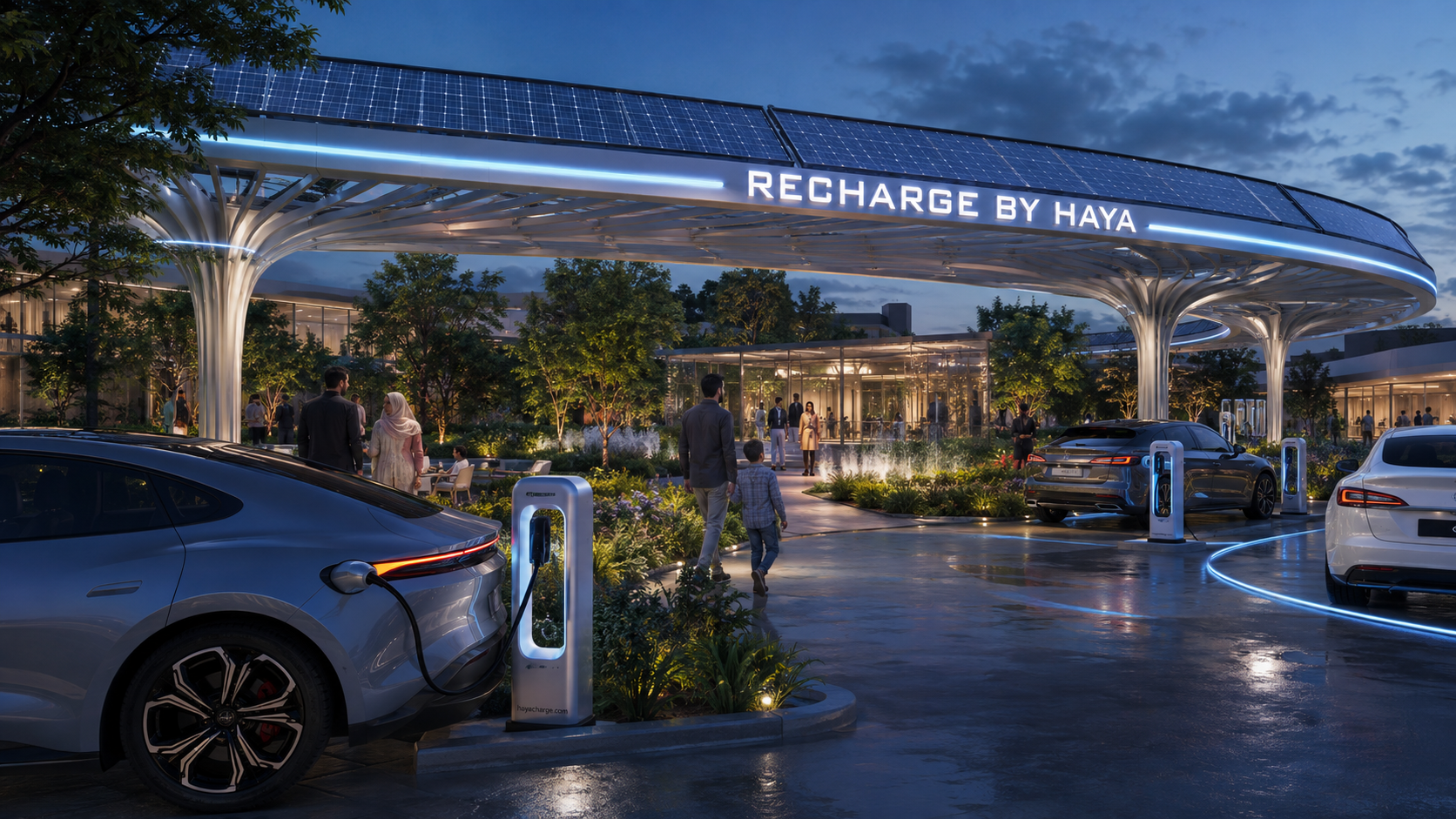
→ Explore Recharge by Haya — EV charging, battery swapping and distributed energy infrastructure.
The opportunity does not stop at two and three wheelers
Two- and three-wheelers are the right place to start, because that is what 77% of Pakistan's vehicle parc actually is, and because the unit economics work first there. But starting there is not the same as stopping there.
The categories that follow matter more than they are given credit for:
Light commercial vehicles and last-mile freight. The vans and small trucks moving goods between warehouse and shop are high-utilisation, return-to-base, predictable-route assets — the profile that electrifies most easily and pays back fastest. They are also almost entirely absent from Pakistan's current EV conversation. The NEV Policy targets fewer than 3,000 electric trucks and LCVs in total across the whole 2025–30 period.[17]
Heavy freight and long-haul trucking. This is the harder problem and the larger prize. Long-haul road freight is where battery-electric hits real limits — payload, range, charging duration, corridor infrastructure — and where the technology question is genuinely open rather than settled. It is also where a corridor economy like Pakistan's, with freight concentrated on a small number of national routes, could in principle be solved with a small number of well-placed assets rather than a dispersed national network.
Buses and mass transit. Fleet-scale, publicly contractible, and the fastest route to visible urban air-quality improvement in cities that need it more than almost anywhere on earth.
The strategic point is this: an operator that builds the energy layer — charging, swapping, distributed generation, storage — is not making a bet on any one vehicle category. Two-wheelers, three-wheelers, light commercial, buses and eventually heavy freight all draw on the same underlying energy estate. The vehicle is the thing that changes. The energy infrastructure is the thing that compounds.
Hydrogen: are we asking the right questions?
Any serious conversation about Pakistan's transport transition now has to address hydrogen, and most of them address it badly — either dismissing it as a decade away, or treating it as an inevitability that makes today's electrification a stranded investment.
Both positions skip the work. The useful questions are narrower and harder:
- In which segments, specifically? Hydrogen's credible near-term case globally is not passenger mobility. It is heavy freight, industrial process heat, and existing industrial hydrogen demand — ammonia and fertiliser production above all, where hydrogen is already consumed today, made from natural gas.[25] Pakistan has a substantial domestic urea and fertiliser industry. The first honest question is whether Pakistan's hydrogen opportunity is a transport story at all, or an industrial decarbonisation story that happens to enable transport later. 2. What does the electricity system say? Green hydrogen is an electricity product before it is a fuel. Pakistan's power sector carries PKR 1.614 trillion (approx. USD 5.8 billion) of circular debt as of June 2025, distribution losses of 17.55% against an allowed 11.43%, and transmission constraints severe enough that the Matiari–Lahore HVDC link, designed for 4,000 MW, has been running at roughly 1,400 MW.[26] Electrolysis at scale is a large new load on a system that cannot currently deliver its existing one. That is a sequencing fact, not an opinion.
- What does it cost, and who pays the difference? If a hydrogen pathway costs more per tonne abated than an electric one, the gap has to be carried by somebody — a subsidy, a concessional lender, an offtaker paying a green premium, or an export market. Naming that party is the test of whether a hydrogen proposal is real.
- Where is the water? Electrolysis consumes water. Pakistan's NDC allocates USD 89.5 billion to universal water and sanitation and its National Adaptation Plan treats the agriculture-water nexus as a first-order priority.[13][27] Any hydrogen plan that does not open with its water balance is not a plan.
- What is the honest timeline, and what would change it? Not "when will hydrogen arrive" but "what specific conditions — cost curve, grid capacity, offtake contract, export demand — would have to be true for this to be financeable here, and are any of them within our control?"
Haya Green's position is that these are open questions and should be treated as open. We are not making a technology bet. We are building the energy and customer layer that survives whichever way the answer goes — because charging, swapping, distributed generation and storage retain their value under an electric pathway, a hybrid pathway, and a hydrogen pathway that arrives later than its advocates hope and sooner than its sceptics expect.
The case for a standing, technology-agnostic review
That position has a practical requirement behind it. If you are not betting on a technology, you need a disciplined way of continuously checking whether you should be.
What that means in practice is a standing technology and optimisation review — not a one-off consultant's report filed and forgotten, but a recurring, structured process with three properties:
Technology-agnostic by construction. The review's job is to test the current pathway against the alternatives on the same criteria — cost per tonne abated, capital intensity, utilisation, residual value, grid dependency, supply-chain exposure, obsolescence risk — with no incumbent option privileged. A review that can only ever confirm the existing plan is a marketing exercise.
Genuinely globally connected. Pakistan's transition will be shaped by decisions taken in Shenzhen, Seoul, Brussels and Washington. Battery chemistry roadmaps, swapping-standard convergence, export-credit policy, tariff regimes, OEM platform decisions. A review conducted only from inside the market will be systematically late to every one of them. It needs people who see the global picture and can read it against local conditions.
Optimisation-led, not advocacy-led. The people best placed to run this are optimisation and systems specialists — people who model networks, utilisation, siting and capital efficiency — rather than technology partisans. The question is not "is hydrogen good." It is "given this demand profile, this grid, this cost of capital and this residual-value risk, what configuration of assets delivers the most abatement and the most durable return, and at what point does that answer change?"
For investors, this is a governance feature, not a nicety. A platform that can demonstrate it is systematically checking its own technology assumptions is a materially lower obsolescence risk than one that cannot. That is a real component of underwriting in a sector where the technology frontier moves faster than the asset life.
Housing should also be treated as climate infrastructure
Climate investment is too often reduced to renewable power generation. Housing belongs in the discussion, and in Pakistan it may be the larger opportunity.
A resilient home affects energy use, heat exposure, sanitation, transport patterns, family health and economic stability. The heat context is not abstract: Turbat, in Balochistan, recorded 53.7°C in May 2017, verified by the World Meteorological Organization as among the highest temperatures ever reliably recorded on earth.[28] The 2015 Karachi heatwave killed more than 1,200 people in eight days, according to the Ministry of Climate Change's own report.[29]
Demand is very large, though the most-quoted number deserves care. The IFC and World Bank put Pakistan's housing deficit at more than 10 million units, widening by around 400,000 a year.[30] That figure is genuinely contested — the Pakistan Institute of Development Economics argues the 10-million number cannot be traced to an original estimate and that Pakistan's problem is better described as inadequate housing than absolute shortage.[31] Both readings point the same way for an investor: the addressable need is measured in millions of units, and the binding constraint is quality and affordability as much as raw count.
Public demand signals are strong and documented. Punjab's Apni Chhat Apna Ghar programme, offering interest-free loans of up to PKR 1.5 million (approx. USD 5,400) over seven years, had disbursed PKR 191 billion (approx. USD 689 million) to 135,410 families by April 2026, with more than 91,000 houses completed and around 42,000 under construction — against more than 1.176 million applications.[32]
And here is the gap that matters most. Pakistan does have a mandatory Energy Conservation Building Code, ECBC-2023, notified in March 2024. But it applies only to buildings above 50 kW connected load or 200 m² of conditioned area.[33] It does not reach the low-income residential segment where the volume actually is. The millions of homes Pakistan is about to build for the people most exposed to heat are being built with no mandatory efficiency standard at all.
That is not a regulatory footnote. It is a decision, being taken now by default, about whether the next generation of Pakistani housing is an adaptation asset or an adaptation liability. Housing designed from the outset around thermal performance, energy efficiency, distributed renewable power, water management, mobility and flood resilience is not merely property development. It is climate infrastructure at household scale — and it is explicitly covered under both the mitigation and adaptation objectives of Pakistan's new Green Taxonomy.[34]
→ Explore Haya Living — affordable, climate-resilient communities.
The financial architecture exists. The pipeline does not.
This is the part global investors most often get wrong about Pakistan. The assumption is that the regulatory and financial plumbing is absent. Increasingly, it is not.
- Pakistan Green Taxonomy (2025) — developed by the State Bank of Pakistan with the Ministry of Climate Change, with World Bank technical assistance. A traffic-light classification covering 55 mitigation activities and 77 adaptation measures, with do-no-significant-harm and minimum social safeguards criteria. Construction is a covered sector under both objectives.[34] In December 2025 the State Bank directed banks and DFIs to use it as the reference for their green banking policies — though it remains advisory, with no compliance deadline.[35]
- Sovereign Sustainable Finance Framework (September 2025) — covering green, social and sustainability bonds and international sukuk, aligned to ICMA principles.[36]
- SECP Green Bond Guidelines (2021), a WAPDA USD 500 million (approx. PKR 139 billion) green Eurobond (2021), and Pakistan's first domestic sovereign green sukuk, PKR 30 billion (approx. USD 108 million), in May 2025.[37]
- IMF Resilience and Sustainability Facility (May 2025) — USD 1.4 billion (approx. PKR 388 billion) across thirteen reform measures, including climate-related financial risk guidelines, corporate climate disclosure, a carbon levy, and the EV subsidy scheme itself.[15]
- A sovereign panda bond, CNY 1.75 billion (~USD 258 million / approx. PKR 71.5 billion) in May 2026, with AIIB and ADB credit support, for climate-resilient water, energy and health infrastructure.[38]
And yet, as of May 2025, Pakistan's entire private corporate green bond market consisted of one issuance: PKR 1 billion (approx. USD 3.6 million), by private placement.[37]
Read those two facts together and the diagnosis is unambiguous. Pakistan does not have a climate-finance architecture problem. It has a climate-project pipeline problem. The instruments exist and are largely unused, because there are not enough bankable, structured, operable assets for them to finance.
That is a solvable problem, and it is a developer's problem before it is a financier's.
Pakistan can become a laboratory for solutions that travel
Climate technologies are usually designed and financed first for wealthy countries. But the real test of a climate solution is whether it works affordably where infrastructure gaps are wider and capital is more expensive.
Pakistan provides exactly that environment — and it has already proved it can adopt at extraordinary speed when the economics work. Between FY23 and FY25, distributed solar generation in Pakistan more than tripled, from 15 TWh to 51 TWh, absorbing the entirety of the country's 33 TWh of electricity demand growth, and rising from 10% to 28% of the generation mix.[39] Ember's analysis of Chinese customs data shows 47 GW of solar panels cumulatively exported from China to Pakistan by June 2025.[40]
Nobody planned that. No subsidy drove it. Consumers and businesses did it themselves, at national scale, in about three years, because grid power was expensive and unreliable and panels became cheap. It is one of the fastest energy transitions by any population anywhere — and it happened bottom-up.
That is the single most important thing a global investor should know about this market. Pakistani consumers do not need to be persuaded to adopt distributed energy. They have already done it, faster than almost anyone. The same conditions — expensive imported fuel, unreliable centralised supply, price-sensitive high-volume consumers — apply directly to electric mobility.
A charging and swapping model that works economically for a Pakistani delivery rider is relevant across emerging Asia, Africa and the Middle East. An affordable climate-resilient housing model that serves industrial workers here has applications across dozens of rapidly urbanising markets. That makes Pakistan valuable not simply as a destination for climate capital, but as a place to build climate business models capable of travelling.
From vulnerability to investability
Pakistan will continue to require concessional finance, development finance and support for adaptation. That need is real and it is not going away — the country ranks 152nd on the ND-GAIN index, with high vulnerability and low readiness.[41]
But that should not obscure a much larger opportunity. Parts of the climate transition create recurring revenues, productive assets and scalable businesses. The task is to connect:
global capital + world-class technology + local execution + measurable impact.
At Haya Green, that is the model we are building across clean mobility and climate-resilient communities: the energy and customer layer beneath Pakistan's transition, built to hold its value whichever technology wins.
Pakistan's climate challenge is enormous. The opportunity is to make the solutions equally ambitious.
References
1 Our World in Data, processing Global Carbon Budget (2025) — Pakistan CO₂ country profile, 2024 data. https://ourworldindata.org/co2/country/pakistan
2 Government of Pakistan with ADB, EU, UNDP and World Bank, Pakistan Floods 2022: Post-Disaster Needs Assessment, October 2022. https://www.undp.org/sites/g/files/zskgke326/files/2022-12/Pakistan%20PDNA%20Main%20Report%20-%20Final.pdf
3 Germanwatch, Climate Risk Index 2026 (data 1995–2024, Pakistan rank 15; HDI-corrected rank 11). https://www.germanwatch.org/sites/default/files/2025-11/CRI%2026%20full%20report.pdf — and Climate Risk Index 2025 (Pakistan ranked 1st for the year 2022). https://www.germanwatch.org/sites/default/files/2025-02/Climate%20Risk%20Index%202025.pdf
4 UN OCHA, Pakistan: Flood Situation Overview, 6 October 2025. https://www.unocha.org/publications/report/pakistan/pakistan-flood-situation-overview-6-october-2025
5 World Bank, Pakistan Country Climate and Development Report, November 2022 (press release). https://www.worldbank.org/en/news/press-release/2022/11/10/pakistan-urgently-needs-significant-investments-in-climate-resilience-to-secure-its-economy-and-reduce-poverty
6 UNFPA statement, 31 December 2025, reported by Dawn. https://www.dawn.com/news/1964235
6a Pakistan Bureau of Statistics, 7th Population and Housing Census (Digital Census) 2023 — 241.49 million. https://www.pbs.gov.pk/ — check before publish: confirm the headline figure on the PBS census page and link to it directly. Note the UNFPA statement at [6] uses "exceeding 225 million", a lower and less current figure; do not present the two side by side.
7 Asian Development Bank, Pakistan National Urban Assessment, August 2024. https://www.adb.org/sites/default/files/institutional-document/988626/pakistan-national-urban-assessment.pdf — and World Bank World Development Indicators (urban population share 39.2%, 2024). https://data.worldbank.org/indicator/SP.URB.TOTL.IN.ZS?locations=PK
8 Ministry of Finance, Pakistan Economic Survey 2025-26, Chapter 13, Table 13.3. https://www.finance.gov.pk/survey/chapter_26/13_Transport_and_Communications.pdf
9 Pakistan Automotive Manufacturers Association data, 13 July 2026, reported by Business Recorder. https://www.brecorder.com/news/40429828/pakistans-car-sales-surge-39-in-fy26
10 NEECA briefing to the Senate Standing Committee on Industries and Production, July 2026, reported by Arab News Pakistan. https://www.arabnews.pk/node/2649654/pakistan
11 Ministry of Heavy Industries, Government of India / Press Information Bureau, 21 July 2026. https://www.pib.gov.in/PressReleasePage.aspx?PRID=2287125
12 International Energy Agency, Global EV Outlook 2026 — electric vehicle charging. https://www.iea.org/reports/global-ev-outlook-2026/electric-vehicle-charging-chap-6-and-10
13 Government of Pakistan, Nationally Determined Contribution 3.0, submitted to the UNFCCC September 2025. https://unfccc.int/sites/default/files/2025-09/Pakistan_NDC3.0_24%20Sep.pdf
14 World Bank, Pakistan Country Climate and Development Report, 2022, as cited in Pakistan's National Adaptation Plan. https://unfccc.int/sites/default/files/resource/National_Adaptation_Plan_Pakistan.pdf
15 International Monetary Fund, Country Report No. 25/109, RSF arrangement approved 9 May 2025. https://www.imf.org/en/-/media/files/publications/cr/2025/english/1pakea2025001-print-pdf.pdf
16 Asian Development Bank, Country Partnership Strategy for Pakistan 2026–2030, launched 18 March 2026. https://www.adb.org/news/adb-launches-new-country-partnership-strategy-pakistan-promote-sustainable-and-inclusive
17 Ministry of Industries and Production, New Energy Vehicle Policy 2025–30. https://moip.gov.pk/SiteImage/Misc/files/NEV%20Policy%20Final%2013_8_25.pdf
18 International Council on Clean Transportation, on Pakistan's 2019 National Electric Vehicle Policy. https://theicct.org/pakistans-national-electric-vehicle-policy-charging-towards-the-future/
19 NEPRA determination TRF-100, 15 April 2025. https://www.nepra.org.pk/tariff/Tariff/Ex-WAPDA%20DISCOS/2025/TRF-100%20EV%20RATIONALIZATION%20OF%20TARIFF%20FOR%20EV%20CHARGING%20STATION%2015-04-2025%205469-72.pdf
20 Press Information Department, Government of Pakistan, NEV Policy launch, 19 June 2025. https://pid.gov.pk/site/press_detail/29435
21 Economic Coordination Committee decision, 5 May 2026, reported by ProPakistani. https://propakistani.pk/2026/05/05/govt-approves-new-subsidy-plan-under-ev-policy/
22 Pakistan Bureau of Statistics data, reported by Profit/Pakistan Today, 31 July 2026. https://profit.pakistantoday.com.pk/2026/07/31/pakistans-fuel-imports-rise-576percent-to-dollar1686-billion-in-fy26
23 IQAir, 2025 World Air Quality Report, released 24 March 2026. https://www.iqair.com/newsroom/waqr-2025-pr
24 World Bank, Pakistan Country Climate and Development Report, §2.4, 2022. https://documents1.worldbank.org/curated/en/099950111072234047/pdf/P17671804998b80030ac4f0233dc0b995ba.pdf
25 International Energy Agency, Ammonia Technology Roadmap. https://www.iea.org/reports/ammonia-technology-roadmap
26 NEPRA, State of Industry Report 2025 (circular debt PKR 1.614tn at 30 June 2025; T&D losses 17.55%). https://www.nepra.org.pk/publications/State%20of%20Industry%20Reports/ — transmission constraint: Sustainable Development Policy Institute presentation to UNESCAP, May 2026. https://www.unescap.org/sites/default/d8files/event-documents/Pakistan's%20grid%20Khalid%20Waleed,%20SDPI.pdf
27 Ministry of Climate Change & Environmental Coordination, National Adaptation Plan Pakistan, 2023. https://unfccc.int/sites/default/files/resource/National_Adaptation_Plan_Pakistan.pdf
28 World Meteorological Organization, verification announcement, 18 June 2019. https://wmo.int/news/media-centre/wmo-verifies-3rd-and-4th-hottest-temperature-recorded-earth
29 Ministry of Climate Change, Government of Pakistan, Heat Wave Report, 3 August 2015. https://mocc.gov.pk/SiteImage/Misc/files/Final%20Heat%20Wave%20Report%203%20August%202015.pdf
30 International Finance Corporation / World Bank Group, Pakistan Housing Finance, 2021. https://documents1.worldbank.org/curated/en/099946508092234254/pdf/IDU0500756780bb12042020b47c0dcd89977c67a.pdf
31 Pakistan Institute of Development Economics, Durr-e-Nayab, The Assumed Shortage of Housing in Pakistan, 2022. https://pide.org.pk/research/the-assumed-shortage-of-housing-in-pakistan-2/
32 Punjab Housing & Town Planning Agency briefing, 22 April 2026, reported by Business Recorder. https://www.brecorder.com/news/40417619
33 NEECA / Pakistan Engineering Council, Energy Conservation Building Code 2023, notified 20 March 2024 via S.R.O. 416(I)/2024. https://www.neeca.gov.pk/SiteImage/Downloads/ecbc23%20(2).pdf
34 State Bank of Pakistan with Ministry of Climate Change & Environmental Coordination, Pakistan Green Taxonomy, 2025 Edition. https://www.mocc.gov.pk/SiteImage/Misc/files/2025%20Pakistan%20Green%20Taxonomy_Aug%2014.pdf
35 State Bank of Pakistan, SH&SFD Circular No. 06 of 2025, 10 December 2025. https://www.sbp.org.pk/circulars/shsfd-circular-no-06-of-2025
36 Press Information Department, Government of Pakistan, PR No. 300, 30 September 2025. https://pid.gov.pk/site/press_detail/30494
37 Securities and Exchange Commission of Pakistan, presentation to the CAREC Programme, 19 May 2025. https://www.carecprogram.org/uploads/S2_Sajjad-Ali_PAK.pdf — Guidelines: https://www.secp.gov.pk/document/green-bonds-guidelines/
38 Asian Infrastructure Investment Bank, 15 May 2026. https://www.aiib.org/en/news-events/news/2026/aiib-adb-support-panda-bond-issuance-for-green-projects-pakistan.html
39 Ember, The solarisation of Pakistan's energy economy, June 2026. https://ember-energy.org/latest-insights/the-solarisation-of-pakistans-energy-economy/
40 Ember, as above, analysis of Chinese customs data.
41 Notre Dame Global Adaptation Initiative (ND-GAIN), Pakistan country profile, 2023 data. https://gain-new.crc.nd.edu/country/pakistan
Explore Recharge by Haya · Explore Haya Living · Speak to Haya Green